


Hut 8 reported over $7 billion of cash, restricted cash, and cash equivalents at June 30, but its Aug. 4 quarterly filing shows that only $233.6 million was unrestricted and available for general corporate use. The other $6.8 billion, or 96.7% of the total, was restricted.
That distinction makes Hut 8’s headline balance a misleading measure of the company’s flexible liquidity if its large AI data-center projects run late or over budget.
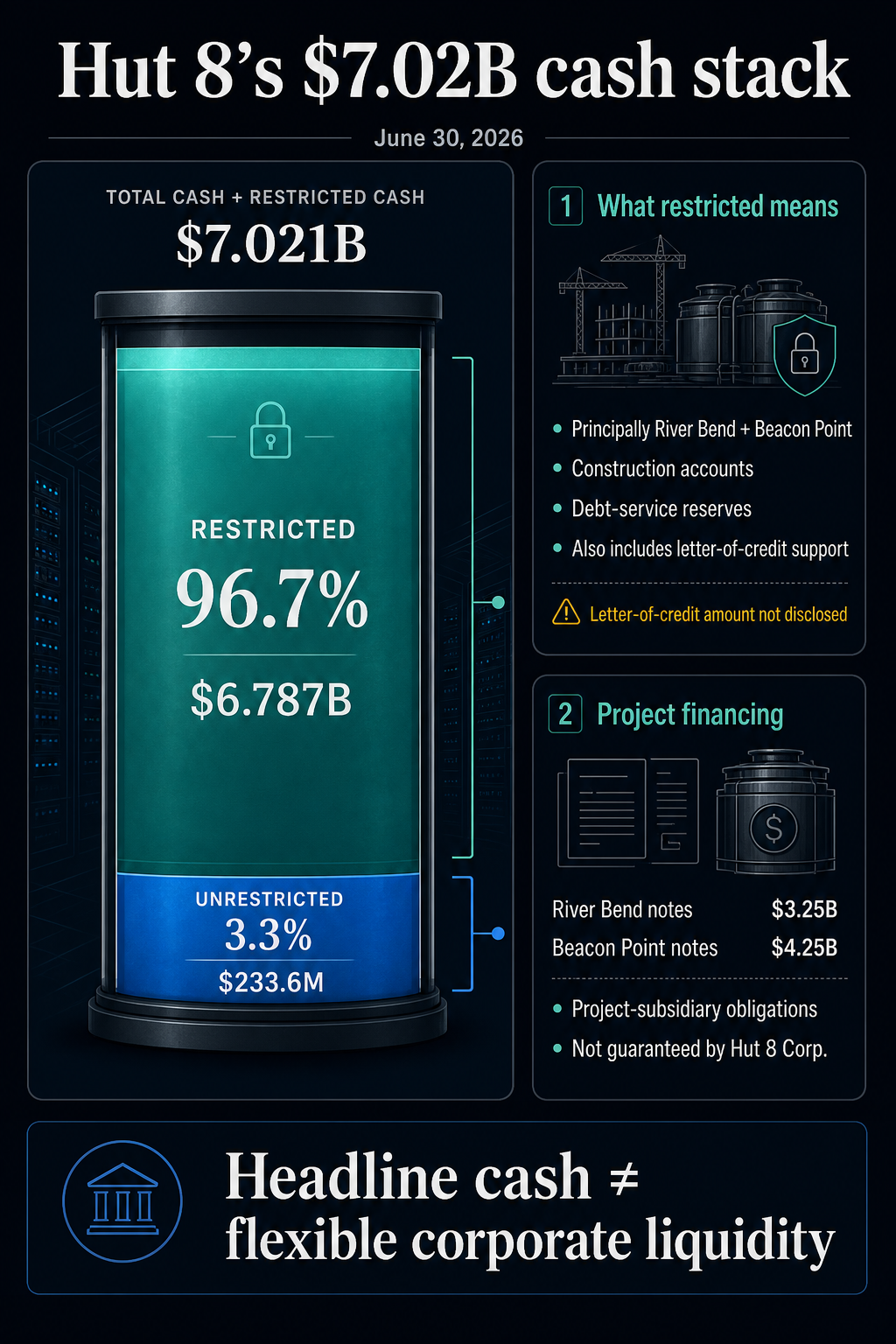
The restricted balance principally consists of proceeds from notes issued for the River Bend and Beacon Point AI data-center developments and held in construction and debt-service reserve accounts required by their indentures. It also includes an unquantified amount supporting commercial letters of credit.
That money can fund construction and related debt service, but it cannot be treated like unrestricted parent-company cash.
The financing also limits Hut 8’s direct exposure to the project debt. River Bend’s $3.25 billion of 6.19% notes are obligations solely of Hut 8 DC LLC, while Beacon Point’s $4.25 billion of 6.13% notes belong solely to Beacon Point DC LLC. Each note package remains isolated at the subsidiary level, with Hut 8 Corp entirely outside the guarantee structure.

Both projects begin paying interest in November 2026, with principal scheduled to start in May 2028 for River Bend and in May 2030 for Beacon Point. Hut 8 leaves open what delay or cost-overrun conditions would require it to contribute additional parent equity beyond the restricted accounts. That threshold is the central unaddressed topic.
Hut 8’s $177.1 million second-quarter net loss included a $138.6 million loss on digital assets that the company described as primarily unrealized.
Under its revised non-GAAP definition, which excludes digital-asset mark-to-market changes, adjusted EBITDA was positive $10.4 million, and it was negative $94.6 million when those changes were included. Both figures are non-GAAP presentations, so cash flow requires its separate measure.
Cash flow presents a less dramatic picture. Hut 8 used $32.8 million of operating cash in the first half and $27.2 million in the first quarter, implying second-quarter operating cash use of about $5.6 million.
The company recorded $51.2 million of interest expense in the quarter, partly offset by $27.1 million of interest income generated mainly by unused River Bend and Beacon Point proceeds. Its maturity table showed no long-term debt principal due in the second half of 2026, with $235.1 million due in 2027.
That 2027 amount includes a $200 million, 7% FalconX loan due April 30. The Bitcoin-backed facility has a 130% margin-call threshold and a 105% liquidation threshold, with lender recourse limited to the pledged Bitcoin.

Hut 8 reported 17,316 Bitcoin across its consolidated group, with 9,314 held by Hut 8 and 8,002 held by American Bitcoin. Separate status buckets showed 9,376 Bitcoin in custody, 3,090 pledged for miner purchases, and 4,850 pledged as collateral.
Hut 8 leaves those buckets unallocated between the two companies, and how much Bitcoin backs FalconX stays undisclosed as well.

Hut 8 has $233.6 million of general-purpose cash, dedicated pools for its projects and no scheduled project-note principal until 2028, but its interest burden and 2027 Bitcoin-backed maturity remain the clearest near-term tests.
The post Hut 8’s $7 billion cash balance shrinks to $233 million outside its AI projects appeared first on CryptoSlate.