


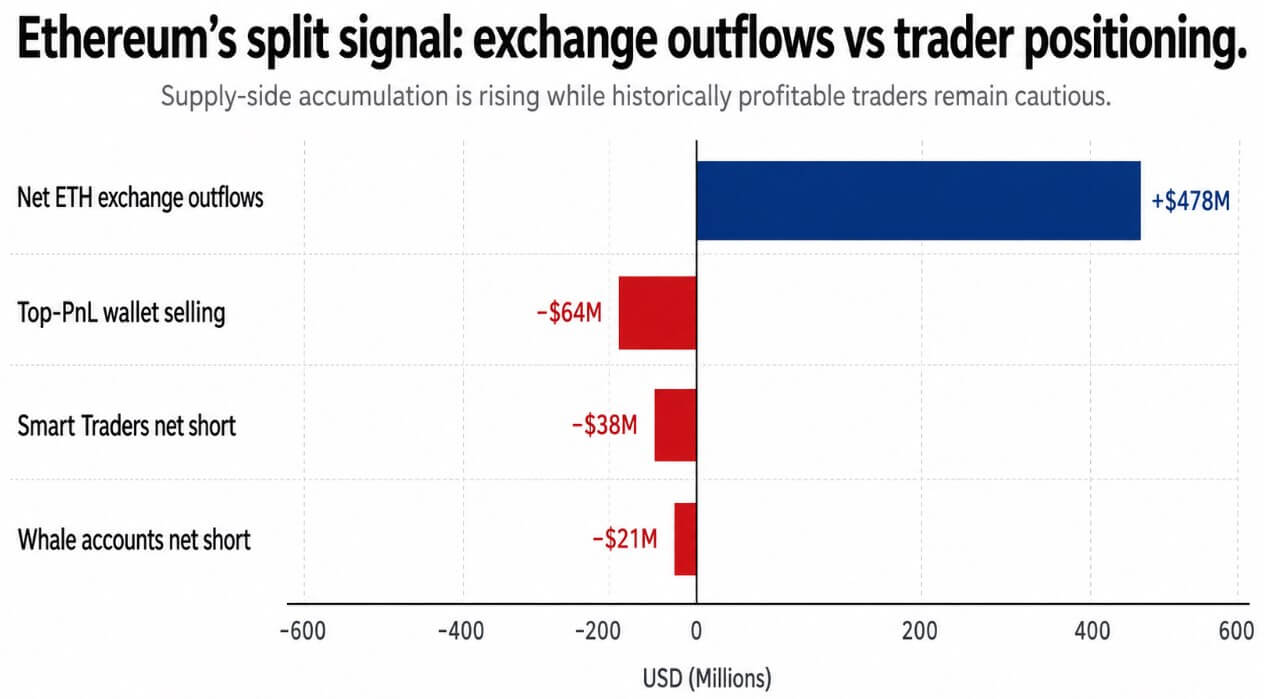
Ethereum has recorded $478 million in net exchange outflows over the last 7 days, a pace running roughly five times above average and the kind of supply-side move traders typically read as accumulation, according to Nansen.
Nansen’s data complicates that reading, as top-PnL wallets sold a net $64 million over the past seven days, and smart traders and whale accounts on Hyperliquid perpetual futures both hold net short positions.
“Smart traders” held $38 million net short, and whale wallets added another $21 million net short on top of that. Those are cohorts the market treats as genuinely informed traders, which gives their skepticism more weight.
Why ETH/BTC is the real scoreboard
The renewed attention traces back to Ethereum’s underperformance against Bitcoin, a gap that widened earlier this year. ETH is down about 37.1% year-to-date, compared with Bitcoin’s 26.2% decline as of July 14, with the ETH/BTC ratio near 0.029.
The bounce from June’s low at 0.025 is short of the levels that preceded Ethereum’s past periods of leadership.
Citi’s March 2026 scenario work gives that recovery a price range to test against, with a 12-month base case near $3,175 and a bull case reaching $4,488 if end-investor demand strengthens meaningfully.
Citi puts its recessionary case at $1,198, a wide spread that shows how much of ETH’s near-term path depends on demand materializing on top of the supply tightening already underway.
The bull case’s own trigger, stronger end-investor demand, names the same gap Nansen’s framework noted, which is capital that shows up and stays.
At Ethereum’s current price, the Nansen outflow amounts to roughly 255,000 ETH, a figure worth comparing against two other numbers.
US-traded spot Ethereum ETFs pulled in about $84.3 million from July 6 through July 10, their first clearly positive week since a stretch of weakness through late June, equal to roughly 45,000 ETH.
The exchange outflow was nearly six times as large as that week’s entire ETF demand. Set against Ethereum’s market cap, the same $478 million amounts to roughly 0.21% of the total, small enough that it serves more as an indicator.
Farside Investors’ data show that July 13 flipped back to a $15.4 million outflow.
| Metric | Approx. value | ETH equivalent | Why it matters |
|---|---|---|---|
| Nansen net exchange outflows | $478M | ~255,000 ETH | Bullish supply-side signal, suggesting ETH is being moved away from venues where it can be sold |
| Spot ETH ETF inflows, July 6–10 | $84.3M | ~45,000 ETH | Shows improving institutional demand, but still much smaller than exchange outflows |
| July 13 spot ETH ETF flow | -$15.4M | ~8,200 ETH outflow | Shows ETF demand has not yet become durable |
| Outflow as share of ETH market cap | ~0.21% | N/A | Large as a signal, but too small alone to prove a supply squeeze |
A usage picture that cuts both ways
DeFiLlama puts Ethereum’s active addresses near 484,966, with 2.7 million transactions and $7.63 billion in seven-day DEX volume, up 27.6% for the week.
The same dashboard shows perpetual futures volume on the network down 48.1% over that period, a split that keeps the activity data from reading as a clean confirmation in either direction.
The network carries roughly $150 billion in stablecoin market cap and RWA.xyz counts more than 1,000 tokenized real-world assets settling on it.
Robinhood’s new chain saw over $70 million in ETH bridged during its first week, a genuine data point for Ethereum’s role as settlement infrastructure, even if still small next to the flows already in question.
Jake Kennis, senior research analyst at Nansen, argued that Ethereum needs sustained multi-week ETF inflows, beyond any single positive stretch, combined with continued growth in active addresses, climbing DeFi total value locked (TVL), and altcoins holding their own momentum.
Together, Kennis says, those readings would point to real capital rotation and renewed risk appetite, distinct from a short-term bounce that fades once the initial supply squeeze eases.
The Fed held its target rate at 3.50% to 3.75% at its June 17 meeting, and June CPI cooled to 3.5% year over year, easing some of the strain that had weighed on risk assets.
Renewed Middle East tension pushed the 10-year Treasury yield back up to about 4.62% at the same time, reviving the kind of yield strain that tends to hit high-beta assets like Ethereum hardest.
Two ways the rotation resolves
If ETF inflows persist for three to four more weeks and ETH/BTC pushes from its current 0.029 toward the 0.032 to 0.035 range, active addresses and DeFi TVL will keep climbing alongside it.
Existing short positioning on Hyperliquid turns into forced covering, adding fuel to the move, and Ethereum gets a real shot at the $2,100 to $2,400 zone.
| Scenario | What has to happen | ETH/BTC signal | ETH price zone | Market interpretation |
|---|---|---|---|---|
| Bullish rotation | ETF inflows persist for 3–4 more weeks, active addresses rise, DeFi TVL climbs, shorts begin covering | ETH/BTC pushes from ~0.029 toward 0.032–0.035 | $2,100–$2,400 | Exchange outflows were early evidence of real accumulation |
| Failed rebound | ETF flows revert negative, usage stalls, top-PnL wallets keep selling, ETH loses $1,800–$1,813 support | ETH/BTC retests ~0.027 or breaks lower | $1,500–$1,650 | Smart traders were right to fade the move |
If ETF flows revert to negative and Ethereum loses the $1,800 to $1,813 zone that has held as support, active-address growth and DeFi TVL stall alongside it. Wallets with large profits keep selling into any strength, ETH/BTC risks retesting June’s 0.027 low or breaking below it, and Ethereum revisits the $1,500 to $1,650 range.
The traders with the strongest records in the same dataset still need convincing, and Kennis’s framework is that Ethereum needs weeks of ETF demand stacked on top of each other, along with on-chain growth that keeps compounding beyond one good print.
Until that framework fills in, ETH/BTC stays the number that settles the argument.
The post Ethereum is flashing a $478 million buy signal but top traders still expect it to fail appeared first on CryptoSlate.